

The Era of Low Growth, Labor Shortages, and Automation
05 Apr 2026Low growth, labor shortages, and automation are not separate issues, but interconnected currents of change. As workforce shortages intensify due to population decline and aging, businesses and society are actively adopting new technologies such as automation and AI to reduce costs and improve efficiency. Even in offline sectors like retail and food service, unmanned and semi-unmanned operations are on the rise, and the scope of technology utilization is broadening, leading to increased competition. However, not all tasks can be replaced by automation, and areas that only humans can handle still exist. In the midst of these changes, it is increasingly important to think about sustainability and the human role together, and to respond with balanced solutions appropriate to each situation.
For quite some time, we’ve become accustomed to hearing the term “low growth”. But rather than chasing a single growth rate figure, it’s more helpful to examine the structural changes happening beneath the surface. In a market that no longer expands as rapidly as before, even maintaining the same sales brings increased pressure to cut costs and boost efficiency. Investment and hiring become more cautious, the threshold for launching new businesses rises, and small businesses and local economies become particularly sensitive to factors like cash flow and fixed costs such as interest rates and rent. That’s why it’s hard to simply dismiss low growth as just a matter of “a poor economy”. The focus in decision-making seems to be shifting from “expansion” to “sustainability” and “survival”. It feels appropriate now to say we live in a time where sustainable operations and profitability come before grand scaling.
 Along with these trends, the reality that hits home most immediately is the labor shortage. Due to falling birth rates and an aging population, the total population is shrinking, and the working-age population is decreasing even faster. Wherever you go-factories, logistics, retail, or service sites-you hear that it’s hard to find people. Even if wages rise, there may be no applicants, or the time required for training and adaptation makes hiring itself burdensome. When the retirement or turnover of skilled workers overlaps, processes quickly become bottlenecked, and undesirable time slots like nights, weekends, or rotating shifts become even harder to fill. This isn’t a short-term issue; there’s a high probability it will deepen structurally over the coming decades. That’s why the core questions for management and policy have become: “How do we reduce or redistribute the work humans have been doing?” and “How do we help the remaining people focus on more valuable tasks?”
One major answer to these questions is technology. Routine and rule-based tasks are rapidly being automated with software, while AI is being applied to areas that require judgment. Tools targeting “efficiency”-from Robotic Process Automation (RPA) to generative AI-are proliferating rapidly. Cloud, APIs, and open-source models have also significantly lowered the barriers to entry. As a result, the competition among solutions targeting the same problems is intense, and merely “using AI” is no longer a differentiator. Only products and services that achieve measurable outcomes-such as genuine cost savings, error reduction, improved customer experience, or successful employee role transitions-will survive. Automation and AI are not cure-alls; they become true “tools” only when organizations can handle the full cost of adoption, operation, security, regulatory compliance, and maintenance.
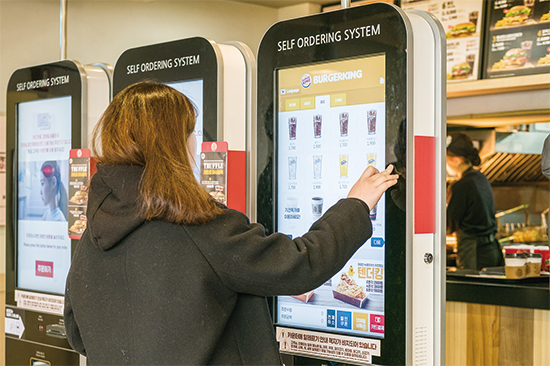 This trend is clearly visible offline, too. In retail and food service, where labor costs and hiring difficulties are high, unmanned stores and minimally staffed outlets are increasingly common. Systems that integrate payment, inventory, access, and monitoring via software and sensors don’t simply “get rid of humans”-they expand operational hours, allow for broader site selection, and leave behind sales and stock data that can inform the next decision. Franchises or businesses with standardized operating procedures are often especially well-suited to unmanned or semi-unmanned models. Of course, there are always areas where human judgment is needed-such as customer service, dispute resolution, emergencies, or caring for the vulnerable. Unmanned operation isn’t the answer for every store, but in an environment where low growth and labor shortages overlap, it has become one of the unavoidable options.
 “To reduce labor costs”… Rising demand for table ordering via tablet
Low growth, labor shortage, automation, and unmanned operations feel less like separate keywords and more like parts of a single chain. As growth slows, the pressure to cut costs increases and the workforce shrinks. To compensate for fewer workers, businesses turn to technology, which in turn changes even offline management practices. Rather than deny this chain, it’s becoming increasingly important to decide together, at each stage, what to preserve and what to change.
Ultimately, the era we live in cannot be explained by growth myths alone. Demographic changes cannot be reversed in the short term, and technology is turning into a fiercely competitive and experimental field. What’s required of companies and developers is not to blindly follow trends, but to carefully consider on-the-ground costs and risks, the evolving role of humans, and to design sustainable solutions. There are now plenty of tools, but it remains up to people to decide where and how to use them. This is the very reason why THENURIM wants to help organizations with software-to support them at exactly this juncture.